


Download, slice and print this model in the MakerSpell app — available on Android and Windows. Get the app
Model Overview & Print Notes
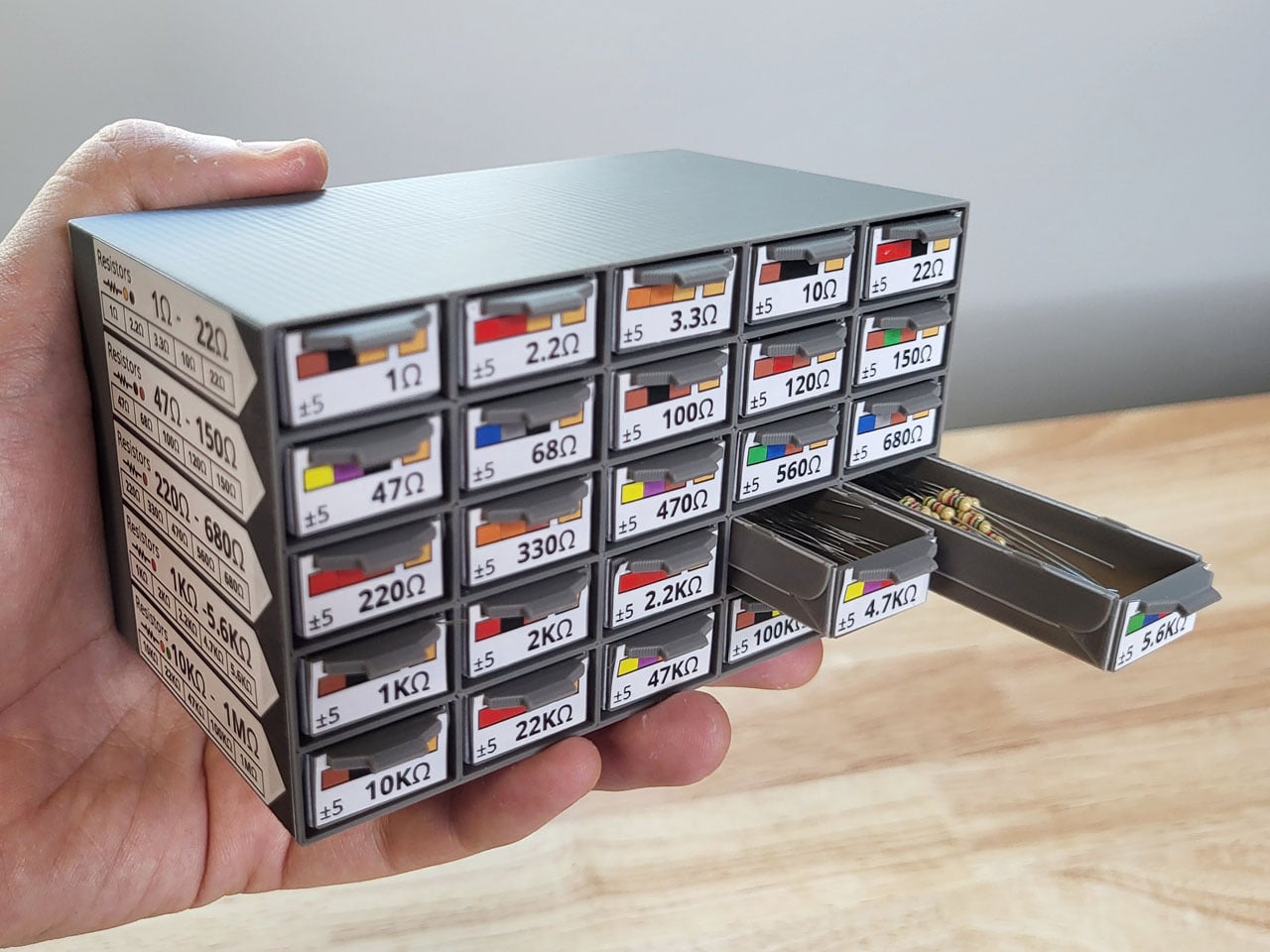
Summary I've been experimenting with designing and printing thin, foldable sheets and thought of creating a small drawer organizer with the idea. Demo and assembly at https://youtu.be/KBI11ScuB-M The folded drawers end up with these "wing" like features that brush up against the cabinet, creating a slightly extra resistance when pulling the drawers out. While it's not much, it's enough so that the drawers will resist slipping out on their own. There are also notches in the cabinet that interfere with the edges of the middle layer of the wall folds: When pushing the drawer all the way in, the last bit of push will often give a satisfying snap action and click sound. When pulling the drawer slowly outward, interference will try to stop the drawer right before it's fully removed. There's also something interesting going on with the handle, involving folding, where the handle can be cantilevered a long distance because its print direction is upward; thus, it doesn't have the same overhang concerns as a non-folded, modeled-in drawer handle. Because this design features numerous small drawers and a folding assembly (approximately 1-2 minutes per drawer), it can require a substantial amount of assembly time. Caveats and Warnings Note that the term "resist" is used very specifically when discussing slipping and spilling, as opposed to being "spill proof". At a certain point, if the box is forcefully mishandled or if the contents inside are heavy enough, the interference and brush friction can give out - and the drawers can slip. Printing PLA or PETG. No supports needed. All models should already be oriented so that the correct side is lying on the print bed. Print a cabinet, and some MiniTray s for the drawers. How many MiniTray s to print will depend on what type of cabinet is printed. Keep in mind that the more drawers you print, the more drawers you'll need to fold/assemble. Print the MiniTray with 0.2mm layer height. When releasing the print from the bed, pull from the handle. Ensure the trays are cooler than the glass-transition temperature of your filament before releasing. Assembly See video for example of assembly. Drawers The drawers are MiniTray model. See folding instructions illustration. Cabinet When placing the drawers into the cabinet, note the notches in the cavity. The cabinet should be oriented so that the notches are closer to the floor than the ceiling. Labels The labels used in the image (and demo video) are provided as both PDF and SVG format. The SVG format is the same source file that they were authored from, in Inkscape. If there are any issues with the resistor labels, let me know, and I will fix them. But I will not be taking on requests to make new labels. The example (shown in gallery and demo video) uses vinyl labels, which are more expensive than paper labels, but have a better finish and adhesion. Updates 10/19/2025 Originally made this thing as a curiosity for a folded drawer design. But since this project has gotten a lot more attention than I originally expected, I've included a more traditional 3D printed drawer design so that it is accessible to a broader audience. It still has the interference at the back to resist being completely slid out. MiniTray_NonFolded has front interference too, to resist accidentally opening. MiniTrap_NonFolded_NoFrontStop will freely slide open. It doesn't have any brushing, so it will slide very smoothly. They're slightly taller and wider than the folded design. Handles are at the bottom to avoid overhang issues. Beyond the initial designs, I won't be following up on requests regarding them (unless there are glaring issues - such as corrupt files). But feel free to comment; maybe someone else will take that as an invitation to remix.
💬Baskı İncelemeleri & Yorumlar(0)
★4.9 / 5.0· Başarılı Baskı