

American Mahjong Card Holder – Easel That Follows the Card's Folds, Standard and Large Print
Download, slice and print this model in the MakerSpell app — available on Android and Windows. Get the app
Model Overview & Print Notes
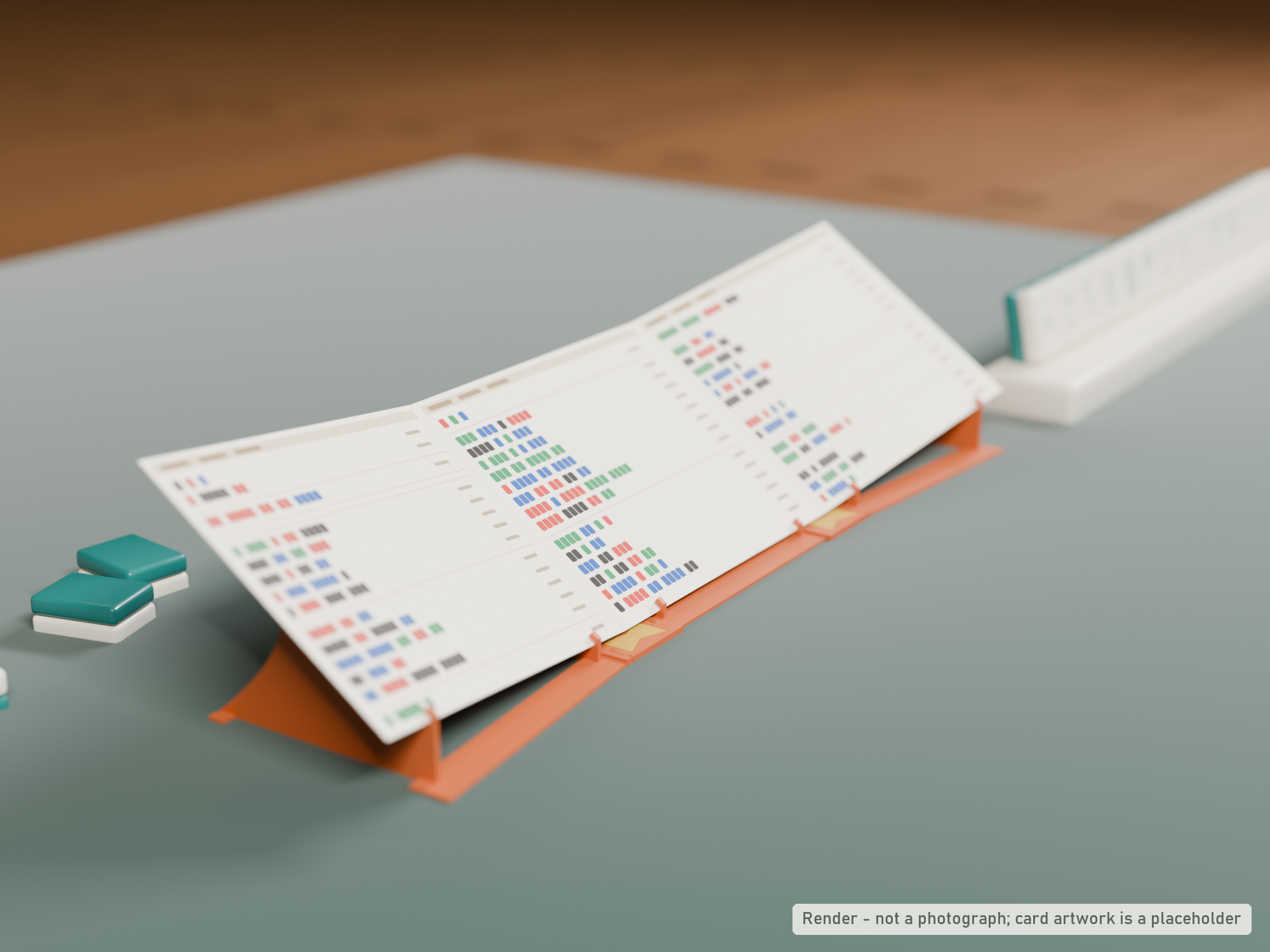
Trifold is a low, reclined easel for the open hand card used in American mahjong - the standard card or the large-print card. The card rests on three slim modules that follow its own folds: the centre panel lies back at 35° and the two outer panels turn 10° towards you about the card's creases, so every panel is supported and faces you . Each panel is carried by two fins, and only a 3 mm lip sits in front of the card's bottom margin - the bottom hands stay visible. The three modules join with interlocking strips and channels plus four drop-in butterfly keys: nothing snaps, nothing is glued, and it stands as one piece and lifts as one piece by its centre module. Validation status (please read): designed and checked in CAD (card fit with 0.4 and 0.6 mm thick cards, drop-in path, joints, calculated stability) and in the slicer (no supports). It has not been physically printed or tested with a real card at a table. All images are renders of the exported CAD; the card shows generated placeholder artwork (not the real annual card) and the table, mat, racks and tiles are generic props - none is a photograph. Not affiliated with, made by or endorsed by the National Mah Jongg League; the card is not included. What you need 3D printed (per player): centre module, left wing, right wing and 4 butterfly keys - no glue, no snaps. Optional: small felt or silicone pads underneath if your mat is slippery. Plus your own open hand card (standard or large print) - the card is not included. Everything is 3D printed - no hardware required. Features Follows the card's folds: centre panel reclined 35°, outer panels turned 10° towards you, every panel carried by two fins over more than half of its height. The card drops in down its own plane and lifts out the same way. Hands stay visible: a 3 mm lip on the bottom margin is the only part in front of the card. One piece once assembled: strips and channels hold every fold up and down on both sides, the keys stop it pulling apart, and feet at both ends of every module stand on one straight front line. Calculated for the standard easel with every fold free to turn: a fingertip press normal to the card at the top of any fin needs at least 4.5 N to tip it, but a push towards or away from you at the card's highest points needs only about 0.3 N - it is a light stand. Low: the card top stands about 85 mm above the table (large print about 98 mm). Each outer panel faces the reader a little better than on a flat 35° stand (calculated for a reference eye 450 mm above the table and 400 mm in front: standard easel 10° off the line of sight instead of 16°, large print 11° instead of 18°) - a small gain; the real gains are the support and the clear bottom row. Made for a matched table: one colour per player, keys in a contrast colour if you like. Sizes Standard card (open 15-3/8 x 4-1/8 in): easel 359 x 104 mm, card top 85 mm above the table; about 58 g and 4 h 54 min per player. Large-print card (open 18-3/8 x 4-3/4 in): easel 434 x 113 mm, card top 98 mm above the table; about 70 g and 5 h 49 min per player. Card sizes come from consistent third-party listings, not an official specification; the easel leaves slack (fins 19 mm from each fold, a 1.6 mm slot). Where it goes Beside your tile rack (left or right, on the table edge) or at a corner of the table - not in front of the rack , where the wall is built every hand. Beside a 19 in rack the standard easel needs a table side of about 34 in (860 mm) or more; use the large-print easel at a corner or a side table. Slide it to move it; lift it by the centre module only, never by a wing. Which files? Standard card : trifold_complete.3mf (all plates) or the single plates trifold_A_centre_keys (centre + 4 keys, ~1 h 46 min), trifold_B_wing_r (~1 h 34 min), trifold_C_wing_l (~1 h 34 min). Large-print card : trifold_large_complete.3mf or trifold_large_A_centre, _B_wing_r, _C_wing_l (~1 h 51-54 min each) and _D_keys (~10 min). STL files of every part for both sizes, and model.py - the CadQuery source (card size, recline, wing turn, fin layout); its interface_checks() re-checks every interface for a new set (needs numpy and scipy; the default command only builds and exports). Print settings PLA (PETG is fine too; light loads, indoors). One colour per player; for contrast keys print the key STL separately from a second spool. 0.4 mm nozzle, 0.20 mm layers, no supports, as placed in the projects: every module standing on its feet exactly as it is used (the fins are vertical plates), keys flat. The modules stand on thin feet - if your bed adhesion is marginal, add a brim. Times above are PrusaSlicer estimates on a generic profile; a set of four standard easels is about 233 g and 19 h 36 min. Assembly Print the centre module (with the 4 keys for the standard card; for large print the keys are on their own plate D) and both wings. Set the centre module on the table. Slide each wing towards it along the table: at each joint pad (front and back) the wing's strip slides into the centre's channel and the centre's strip into the wing's channel. Keep both flat on the table and slide straight until it stops; if it stops early, move the wing a hair away from you and push again. Drop a key into each pair of key pockets across the joints (two per joint); if a key does not drop in, ease the wing back a hair. Before the first use, open the card fully and run a finger along both creases so it lies nearly flat; then slide it down onto the fins until its bottom edge sits behind the lips. To lift the card out, slide it up its own plane. To pack the easel away, lift the keys out and slide the wings off. Limitations Not physically printed or tested; readability angles and tipping forces are calculations. A card whose creases stay strongly folded (more than about 10°) pushes its outer bottom corners against the lips and its outer panels curl forward off the fins - flatten the creases first. The fins carry the card over a little more than half of its height; the upper rows are paper and flex if pressed. Each fold has a little play: a light touch at the top of a module (from about 0.10 N, calculated) can rock it about 3° at a wing's top corner (rigid CAD) until the joints take hold; a firmer push leans it further as the thin joint strips flex, and tipping the easel sideways takes at least 1.1 N. Lifted by the centre module, the wings hang about 3° in the rigid CAD and roughly 5-6° (7-8° for large print) once the thin joint strips flex, until it is set down. The keys are small parts - keep them away from small children; not a toy. Pictures Renders of the exported CAD, not photographs: the easel holding the open card beside a tile rack (cover), how it follows the folds, a four-colour table set, the front, the side, the drop-in keys, the parts in their print poses, the two sizes and the rear. The card artwork is a placeholder.
💬Baskı İncelemeleri & Yorumlar(0)
★4.9 / 5.0· Başarılı Baskı